You wake up to an email.
It's from a law firm.
"Your website is not accessible to people with disabilities. This violates the Americans with Disabilities Act (ADA). We demand you make immediate changes or face litigation."
Your heart sinks.
You're not alone.
Shopify store owners are getting these emails constantly in 2026.
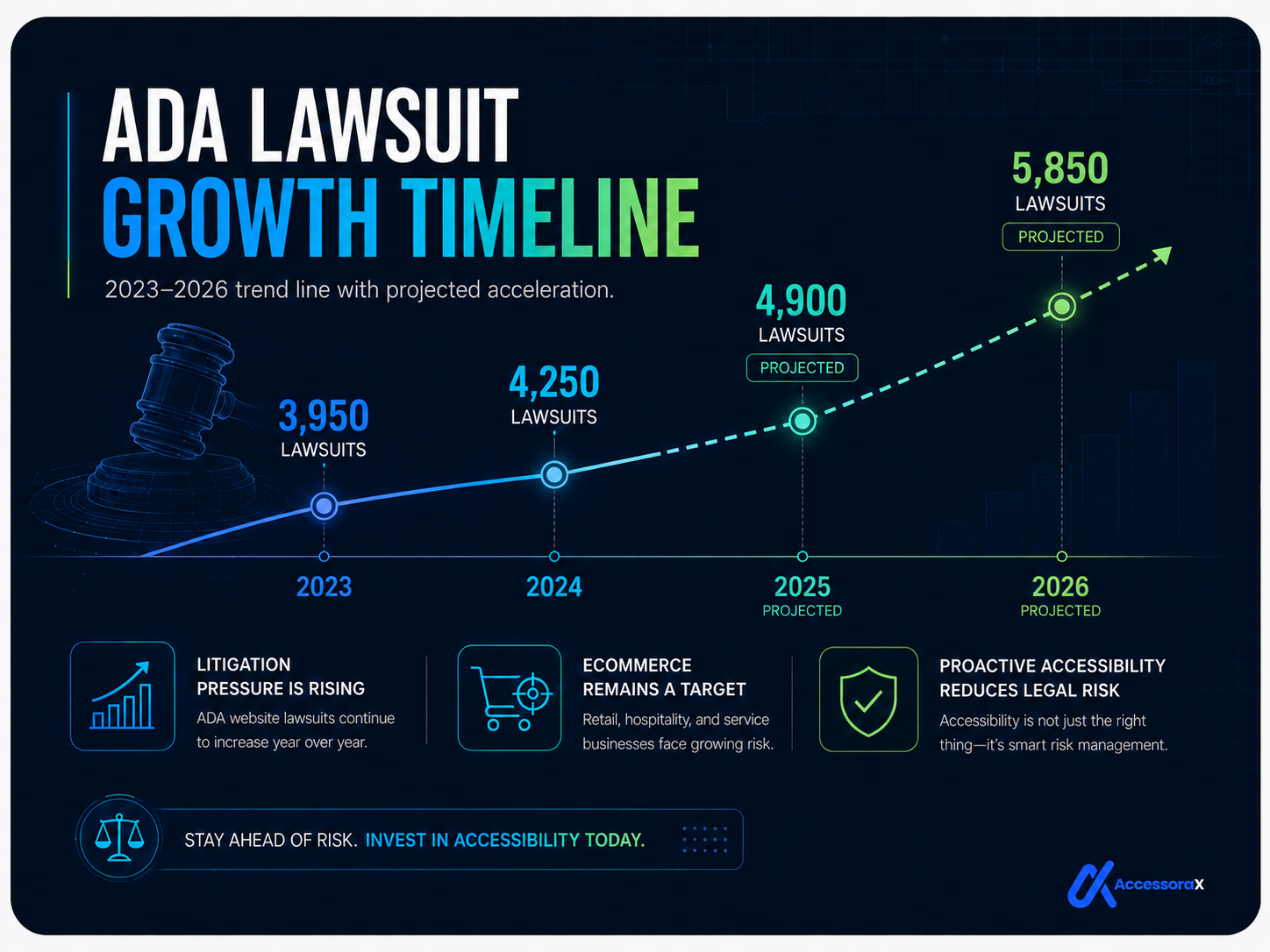
ADA digital lawsuits have exploded from 3,500 in 2023 to over 5,200 in 2025.
And e-commerce sites are the #1 target.
This guide explains
- Why Shopify stores are being sued
- What triggers accessibility complaints
- Who's actually filing these lawsuits
- How much it costs to defend yourself
- How to protect your store NOW
The Reality: ADA Lawsuits Are Real and Increasing
By The Numbers
- 2023: 3,500 ADA digital accessibility lawsuits filed
- 2024: 4,500 ADA digital accessibility lawsuits filed
- 2025: 5,200+ ADA digital accessibility lawsuits filed
- 2026: Trend accelerating (Q1 2026 already at 1,200+ lawsuits)
That's roughly 1 new lawsuit every 45 minutes.
Who gets sued:
Why small businesses?
Because they:
- Can't afford expensive legal defense
- Often settle quickly
- Have obvious accessibility violations
- Don't have legal teams
Average Cost of ADA Digital Lawsuits
If you get sued:
| Item | Range | Average |
|---|---|---|
| Settlement amount | $15,000-$35,000 | $22,000 |
| Legal defense fees | $10,000-$25,000 | $15,000 |
| Total | $37,000 |
Add to that:
- Time managing litigation: 100-200 hours
- Lost business/distraction: Significant
- Brand damage: Priceless
For comparison: professional accessibility remediation costs $199-$500.
The math is staggering.
Why Lawsuits Are Accelerating
Factor 1: Easier to File
Lawsuits don't require proof of harm to a real person.
They just require proof that the website violates WCAG 2.1 standards.
Any accessibility scanning tool can prove this in minutes.
Factor 2: Law Firms Specializing in This
Firms have discovered a profitable niche.
They find websites with obvious violations. They send demand letters. Many store owners settle rather than fight.
This incentivizes more lawsuits.
Factor 3: Legal Precedent
Courts have repeatedly ruled that:
- Websites are "public accommodations" under ADA
- WCAG 2.1 Level AA is the compliance standard
- Store owners are liable for violations
- Accessibility overlays don't fix the problem
These precedents make it easier for plaintiffs to win.
Factor 4: Awareness Among Plaintiffs
People with disabilities know their rights.
They're increasingly willing to file suits for websites they can't access.
Some use lawsuits as legitimate advocacy tool. Some (sadly) just want settlements.
Either way: More suits.
Why Shopify Stores Are Targeted
Reason 1: High Volume of Easy Targets
There are 4+ million Shopify stores.
Most are NOT fully accessible.
That's 4 million targets for plaintiff attorneys.
Reason 2: Obvious Violations
Most Shopify stores have obvious violations:
- Missing alt text on product images (visible to automated tools)
- Color contrast failures (easy to detect)
- Form fields without labels (automated scanners find immediately)
- Keyboard navigation broken (easy to test)
These violations are easy to prove, hard to defend, and quick lawsuit wins.
Reason 3: High-Value Target
E-commerce stores:
- Generate revenue (money to settle with)
- Have customer data (care about brand)
- Fear disruption (want it resolved quickly)
This makes them attractive settlement targets.
Reason 4: Accessibility is Overlooked
Many Shopify store owners:
- Don't know about ADA requirements
- Think Shopify handles everything
- Haven't audited their sites
- Have no documentation of accessibility efforts
This ignorance makes defense difficult.
Reason 5: The "Low Hanging Fruit" Problem
Plaintiff lawyers find Shopify stores because:
- They're easy to scan (automated tools)
- They have obvious violations (quick proof)
- Owners are unprepared (quick settlement)
- Remediation is affordable (makes settlement reasonable)
This cycle perpetuates more lawsuits.
Real Lawsuit Examples: What Actually Happens
Example 1: The Demand Letter
What happens:
A visitor (or their lawyer) scans your Shopify store with accessibility tools. Finds 50+ violations. Sends you a demand letter.
The letter says:
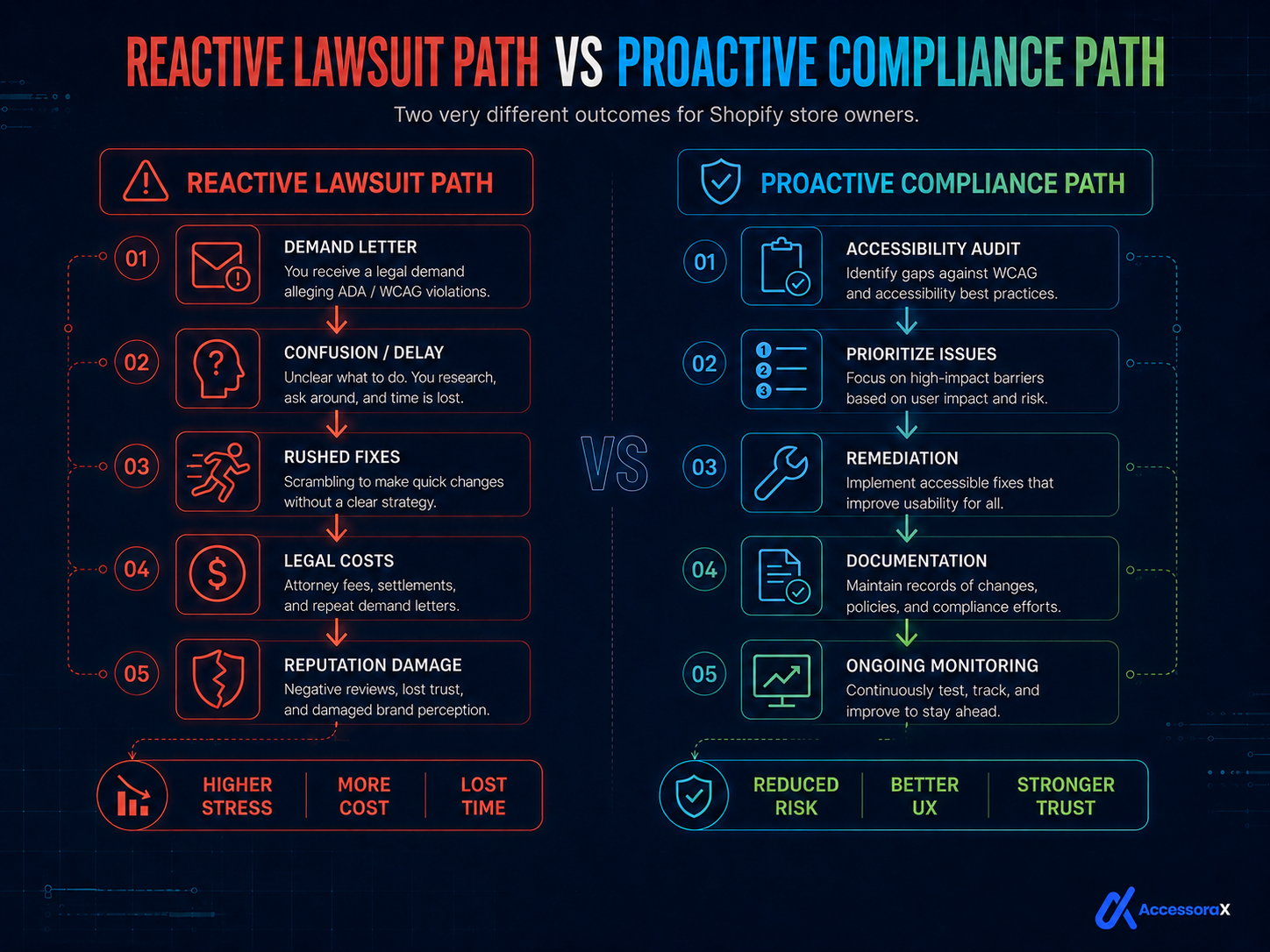
What happens next:
- You panic.
- You hire a lawyer ($2,000-5,000 for initial consultation).
- Your lawyer says: "Settlement is likely cheaper than litigation."
- You settle ($15,000-35,000).
- You fix your site ($200-500).
Total cost: $17,200-40,500
Could have been: $200-500 (proactive remediation)
Example 2: The Actual Lawsuit
What happens:
Demand letter is ignored. Lawsuit is filed.
Discovery phase (6-12 months)
- Exchange documents
- Depositions
- Expert reports
- Accessibility audits
Cost so far: $10,000-20,000
Settlement phase (12-18 months)
- Negotiation
- Settlement offer ($25,000-50,000+)
- Sign settlement agreement
- Begin remediation
Total cost: $35,000-70,000+
Plus 200+ hours of your time, significant business disruption, and negative press or reputation damage.
Example 3: The Proactive Store Owner
What happens:
Store owner gets demand letter.
Response:
"I take accessibility seriously. I've already been working on compliance. Here's my audit report showing violations and my remediation plan with timeline. I'm implementing fixes immediately. No settlement requested — I'm just fixing my site."
Outcome:
Plaintiff's lawyer may drop the case (no settlement = no profit).
Even if case proceeds, you have documentation showing:
- You knew about the issue
- You were fixing it
- You have documented remediation plan
This is MUCH stronger defense.
Who Is Filing These Lawsuits?
Type 1: Legitimate Disability Advocates
Who they are: People with disabilities who genuinely can't use inaccessible websites.
They file suits to:
- Force businesses to comply with law
- Advocate for equal access
- Hold companies accountable
Motivation: Justice · Settlement expectations: Reasonable
How to respond: Take them seriously, fix your site immediately
Type 2: Plaintiff's Law Firms
Who they are: Firms that specialize in ADA digital lawsuits.
They scan websites automatically, find violations, send demand letters, and settle or litigate.
Motivation: Profit · Settlement expectations: High (it's their business model)
How to respond: Still take seriously, still fix your site
Type 3: Professional Plaintiffs
Who they are: Individuals who file multiple lawsuits against websites.
They use automated tools to find violations. They (or their lawyers) file many suits. Settlements go to them or lawyers (not real disabled users).
Motivation: Money (unfortunately) · Settlement expectations: Whatever they can get
How to respond: Still treat seriously legally, but don't panic — these are often easier to defend with proper documentation
Type 4: Accessibility Testing Services
Who they are: Companies that audit websites for accessibility. Some also file lawsuits if sites aren't compliant.
Motivation: Business (referrals to their remediation services) · Settlement expectations: Structured
How to respond: Take seriously, fix proactively
Why Shopify Store Owners Are Vulnerable
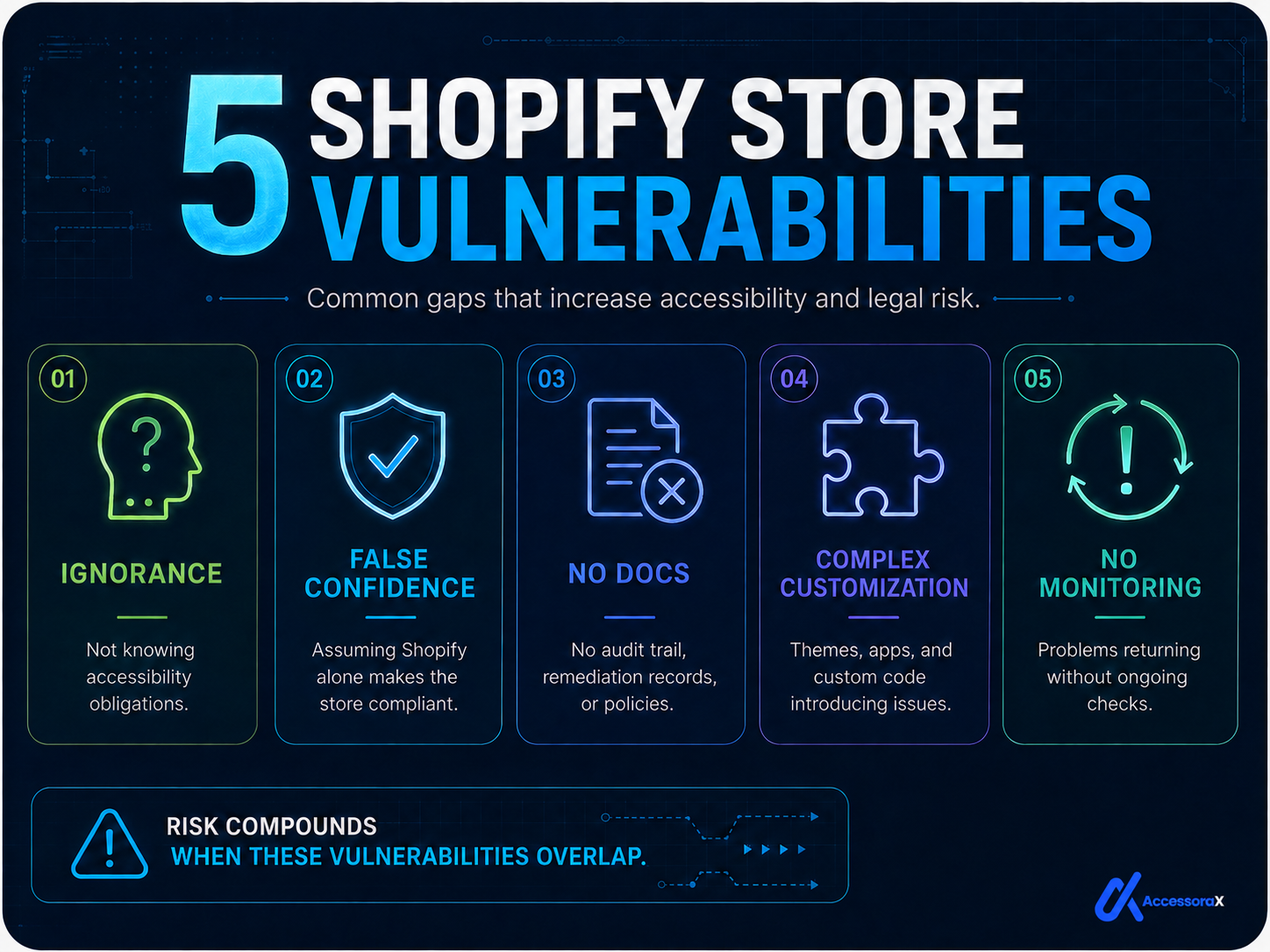
Vulnerability 1: Ignorance
Most store owners don't know:
- ADA applies to websites
- WCAG 2.1 is the legal standard
- They can be sued
- Compliance costs $200-500
Vulnerability 2: False Confidence
Many think:
- "Shopify handles accessibility" (partly true, but not complete)
- "I don't have disabled customers" (irrelevant — ADA covers all)
- "I'll deal with this later" (too late once sued)
Vulnerability 3: Lack of Documentation
Most store owners have:
- Zero accessibility audit
- No remediation plan
- No documentation of efforts
- No proof of compliance
This makes defense impossible. If sued, you can't prove you took reasonable steps.
Vulnerability 4: Complex Customization
Many Shopify stores use custom themes, install multiple apps, add custom code, and customize forms.
Each customization introduces violations. Store owner is liable for ALL of it.
Vulnerability 5: No Monitoring
Once built, most stores are never tested for accessibility again.
- New apps can break accessibility
- Shopify updates can introduce issues
- Site changes can create violations
No monitoring = violations accumulate.
What Accessibility Violations Trigger Lawsuits
Most common violations in successful lawsuits:
Critical Violations (Almost Always Sued Over)
Trigger #1 Missing Product Image Alt Text
- Blind users can't see products
- Easiest violation to prove
- Affects 60%+ of Shopify stores
Trigger #2 Inaccessible Checkout
- Deaf or motor-disabled users can't buy
- Directly blocks revenue
- Clear proof of discrimination
Trigger #3 Broken Keyboard Navigation
- Motor-disabled users can't navigate
- Easy to test and prove
- Clear accessibility barrier
High Violations (Often Sued Over)
High Color Contrast Failures
- Low-vision users can't read
- Easy to scan with tools
- Clear WCAG 1.4.3 violation
High Form Labels Missing
- Screen reader users don't know what to enter
- Blocks purchase for many users
- WCAG 1.3.1 violation
High Video Without Captions
- Deaf users can't watch product videos
- Clear violation
- Less common (fewer stores have video) but serious when present
Medium Violations (Sometimes Sued Over)
- Heading hierarchy issues — harder to prove discrimination, but still violation
- Link context unclear — some users need better context, less obvious violation
- Navigation structure issues — harder to affect actual users, less common lawsuit trigger
How to Protect Your Shopify Store NOW
Step 1: Get Audited (This Week)
Do not wait for a demand letter.
Get professional accessibility audit to know your status.
You'll know exactly what violations exist, the severity of each, the cost to fix, and your timeline to compliance.
Step 2: Fix Critical Issues (This Month)
Prioritize and fix:
- Alt text on product images
- Checkout accessibility
- Keyboard navigation
These three are responsible for 80% of lawsuits. Fixing them eliminates most risk.
Step 3: Document Everything
Create a file containing
- Original audit report (dated)
- Violations found
- Remediation plan (dated)
- Proof of fixes implemented
- New audit showing compliance
This documentation is your DEFENSE if sued.
Step 4: Maintain Compliance (Ongoing)
When you:
- Add new products (add alt text immediately)
- Update site (test for new violations)
- Install new apps (audit for accessibility)
- Change design (verify keyboard navigation)
Test for new violations regularly.
Step 5: Get Legal Insurance
Some business insurance policies cover ADA digital lawsuits.
Ask your insurance agent:
- "Do you cover ADA digital accessibility claims?"
- "What's the coverage limit?"
- "What's the deductible?"
Good insurance can reduce financial risk.
What NOT to Do If You Get a Demand Letter
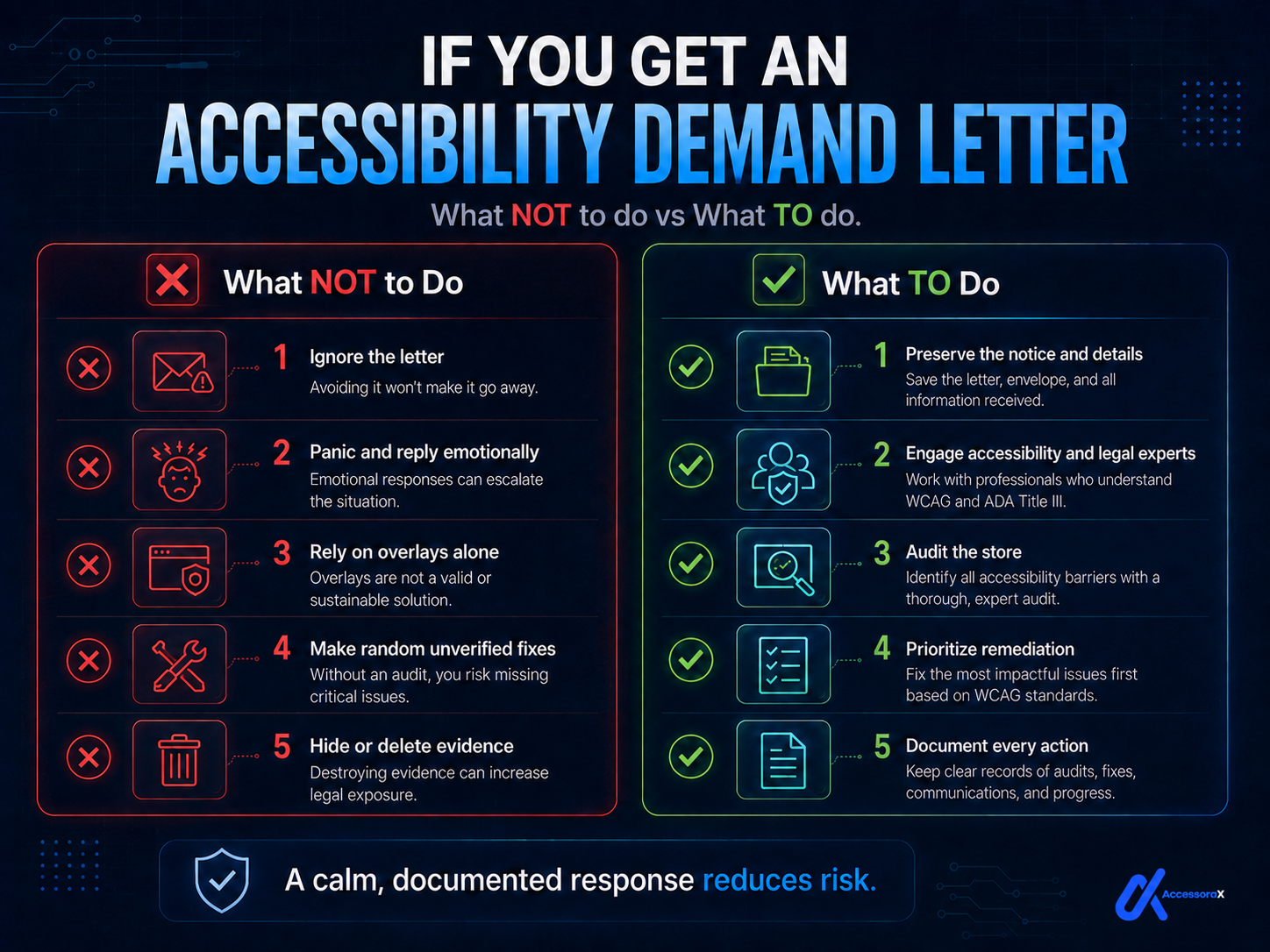
DON'T: Ignore It
Ignoring a demand letter doesn't make it go away, leads to actual lawsuit, and shows bad faith (makes damages worse).
DO: Take it seriously, respond promptly
DON'T: Panic
Demand letters are scary but manageable. Most cases settle for $15,000-$35,000. Many cases resolve without settlement if you respond proactively.
DON'T: Settle Immediately
Don't settle the same day without:
- Talking to a lawyer
- Understanding the demands
- Having a remediation plan
- Getting a quote for fixes
Some demand letters are inflated. A lawyer can negotiate.
DON'T: Ignore Legal Counsel
Get a lawyer experienced in ADA digital lawsuits. Initial consultation: $500-2,000 (worth it).
A good lawyer can evaluate demand validity, negotiate settlement, structure payment terms, and help with remediation.
DON'T: Use Accessibility Overlays
Don't install "fix everything" widgets claiming instant compliance.
Courts have ruled these don't actually fix accessibility, may increase liability (admission of problem), waste money, and delay real fixes.
DO: Fix actual issues instead
Know your exact risk level
Find out what violations exist on YOUR store. Know what a lawyer would find.
Get your free professional accessibility audit →Legal Standard: Why Shopify Stores Must Comply
The ADA
The Americans with Disabilities Act (1990) prohibits discrimination based on disability.
Title III covers public accommodations:
"No individual shall be discriminated against on the basis of disability in the full and equal enjoyment of the goods, services, facilities, privileges, advantages, or accommodations of any place of public accommodation."
E-commerce websites are public accommodations.
Not being accessible = discrimination.
The WCAG Standard
When courts evaluate if a website discriminates, they use WCAG 2.1 Level AA.
This standard:
- Is created by W3C (international web standards body)
- Has 50 specific criteria
- Is measurable and testable
- Is updated regularly
- Is used in every major ADA digital lawsuit
If your site doesn't meet WCAG 2.1 Level AA, courts will find you non-compliant.
The Precedent
Multiple courts have ruled:
Domino's Pizza (2019)
- Pizza chain website not accessible
- Customers with disabilities couldn't order
- Settlement: $3 million
- Standard used: WCAG 2.1
Target Corporation (2008)
- Target.com not accessible
- Blind users couldn't shop
- Settlement: $6 million
- Ruling: ADA applies to websites
Winn-Dixie (2017)
- Grocery store website not accessible
- Settlement: Multi-million
- Ruling: ADA applies to e-commerce
These precedents apply to your Shopify store.
How This Affects Your Store
Financial Impact
If you're inaccessible
- Annual lawsuit risk: 2-5% chance
- If sued, cost: $25,000-$60,000
- Expected annual cost: $500-$3,000/year
Over 3 years: $1,500-$9,000
If you're compliant
- One-time remediation: $200-$500
- Annual maintenance: Minimal
Expected cost: $0
Business Impact
If you're inaccessible
- Risk of lawsuit (stress, time, money)
- 61 million disabled Americans can't use your site
- Missing 15-20% of potential customers
- Negative PR if sued
If you're compliant
- No lawsuit risk
- Accessible to ALL customers
- Positive brand image
- Better SEO rankings
Legal Impact
If you're inaccessible
- Violating federal law
- No documentation (bad in court)
- Difficult to defend
- Higher settlements
If you're compliant
- Following federal law
- Documentation proving compliance
- Easier to defend if sued anyway
- Lower settlements if sued
Summary: Why Shopify Stores Get Sued for Accessibility
Shopify stores are sued because:
- There are 4+ million of them (huge target base)
- Most have obvious violations (easy to prove)
- Store owners are unprepared (quick settlements)
- ADA lawsuits are profitable (lawyers file them)
- Legal precedent is established (courts favor plaintiffs)
Average cost if sued: $25,000-$60,000
Cost to prevent being sued: $200-$500
Timeline to fix: 2-4 weeks with professional help
Ready to eliminate your lawsuit risk?
Professional remediation: 100% WCAG 2.1 AA compliance in 10-14 days. Includes documentation proving compliance. Protects you legally.
View our Shopify accessibility remediation services →Want to understand what lawyers look for?
Read our complete WCAG 2.1 requirements guide →
This is exactly what courts require.
Don't Wait
Lawsuits aren't slowing down. They're accelerating.
The stores getting sued today are the ones who ignored accessibility yesterday.
Don't be next. Fix your site this month.